
BECOME AN NATIONAL COASTEERING CHARTER
COASTEER GUIDE
N.C.C Coasteering Guide Courses in Cornwall with Vertical Descents
We offer the very best Coasteering Guide Courses and CPD training
We have 5 professional National Coasteering Charter courses available, from beginner courses for those looking to start a career in Coasteer Guiding, through to experienced Coasteer Guides looking to raise their standards to a recognised level, maintain their awards, and stay up to date with the latest Coasteering Instructor standards and CPD.
To start your journey, everyone begins with the minimum ability and either completes our 6-day Coasteer Guide Course or meets the standards and hours to do the 2-day N.C.C Coasteer Guide followed by 1 Day NCC Coasteer Guide Assessment. .


Searching Availability...
Why choose Vertical Descents Cornwall Adventure Training Centre for your NCC Coasteer Guide Training?
- Fully Qualified N.C.C Trainer and Assessor
- AALA Licensed & Inspected
- DBS Checked Staff
- Adventurous Activities Insured
- WiSe Adventure trained - The WiSe Scheme is about watching marine wildlife the wildlife-safe way
- The Best Equipment included for your comfort and safety
- All weather activity
- Based on the North Coast of Cornwall for the best wild terrain training spots
- Courses Book able online below - Select a course from the drop down boxes below
We are a leading company in Coasteering and offer coasteering guide training courses for Coasteering skills and coaster guiding skills. A part of this is Lead guide Assessments and technical support and advice for businesses.
Offering Both scheduled and bespoke training and assessment courses means you can contact us if you cant find a date that suits you.
The training and assessment courses that we offer are NCC recognised. The National Coasteering Charter (NCC) Coasteer Guide Award program has been developed by a community of highly experienced Coasteer leaders and technical experts to create a foundation for all guides and providers.
The NCC Training course is 2 days and you must fulfill prerequisites in order to enroll on the course
The NCC Assessment is a full day and you must fulfill the prerequisite requirements before enrolling on an assessment – see below for more information.
Our Trainer Assessor is one of only 2 in Cornwall and has been a part of the NCC since its conception. Being voted to be a Trainer and Assessor by the Cornish Coasteering community and having gone through a rigorous selection process from a group of piers. Sam Starkie has over 25 years of Coasteering experience, ensuring you learn loads but have a fantastic time doing so.
National Coasteering Charter - Coasteer Guide Training Award - 2 Days
WHAT DOES THE COURSE COVER?
This NCC Coasteering Guide training award covers all areas of Coasteer guiding, including operating procedures, Equipment issue, Safety talk, guiding skills, group management, safety and rescue skills, route choice and grading, risk management, and first aid in the coasteering environment. This course will cover all areas of Coasteering rescues and recovery, including how to deal with the emergency services.
- 2 Days
- Guides, Trainee, and Assistant guides
This is Step 1 on the NCC ladder toward becoming a qualified Coasteering Guide.
- Age: 16+
- Ability Level: Strong Swimmers only
- Timed Swim: Surf Lifeguard Award - 400m Under 7 min 30 seconds
- Timed Run: 200m under 1 minute
- Ideal for : For fit & health Intermediate to seasoned Coasteer Guides
- Adrenaline Rating : 10/10
- Duration: up to 8+hrs per day
- Includes all specialist equipment - You'll need to bring your own kit and standard Guide P.P.E safety gear
- Accessed & Trained by N.C.C Qualified Trainer & Accessors
ABOUT THE COURSE
The NCC Coasteering Guide training award covers all aspects of coasteer guiding, from Safety and rescue to group and risk management, to operating procedures and route choice. You will spend two days coasteering in A variety of locations and looking at all techniques available to deliver a safe coasteering session.
COURSE PREREQUISITES
First Aid Qualification (this can be completed after the course) although it is preferable to have prior to attendance. The NCC recommends a 2 day outdoor specific first aid course. Complete a pre-course online learning module.
ABILITY
You must have at least 10 hours personal coasteering experience and 10 hours of commercial Coasteering experience.
REMIT
This is for commercial Coasteering venues which are within the remit of the NCC recommendations.
AGE
Minimum age 18
NCC Coasteer guide training £150 + You must have a valid NCC Membership – click here to join
Duration – 2 day
- STEP 1 – YOU’VE BECOME A MEMBER OF NCC or ALREADY ARE – Click here to join.
- STEP 2 – COMPLETED THIS TRAINING AWARD
- AFTER THIS YOUR NEXT STEP – STEP 3 – NCC COASTEERING GUIDE ASSESSMENT
SEE BELOW TO FIND DATES, AVAILABILITY AND TO BOOK ONLINE
Searching Availability...
Our Coasteer Guide Training Course - 6 Days
Do you want to become a Coasteering Guide?
Do it in a week… 6 Days of intensive training with an Assessment at the end to walk away with an NCC Coasteering Guide Qualification.
This 6 day Intensive NCC Coasteering Guide training course covers all areas of Coasteer guiding and will allow you to lead coasteering and work as a coasteering guide.
In 5 days you will learn everything you need to know on how to be a complete coasteering guide. You will have 5 intensive days of coasteering with 10 hour days of training both on and off the water. On day 6 you will be assessed by an external NCC Coasteering trainer and assessor to ensure validity of the training and ensure a fair assessment of your ability to lead coasteering.
- 6 Days
This is the journey to becoming a qualified Coasteering Guide.
- Age: 18+
- Ability Level: Strong Swimmers only
- Timed Swim: Surf Lifeguard Award - 400m Under 7 min 30 seconds
- Timed Run: 200m under 1 minute
- Ideal for : For fit & health Beginner to seasoned Coasteer Guides
- Adrenaline Rating : 10/10
- Duration: up to 8+hrs per day
- Includes all specialist equipment - You'll need to bring your own kit and standard Guide P.P.E safety gear
- Accessed & Trained by N.C.C Qualified Trainer & Accessors
ABOUT THE COURSE
This intensive 6 day NCC Coasteering Guide training course covers all aspects of coasteer guiding. This includes Coasteering Operating procedures, Equipment issue, Safety talk, guiding skills, group management, safety and rescue skills, route choice and grading, risk management, first aid in the coasteering environment.water hydrology, weather and swell, and the coasteering environment.
This course will cover all areas of Coasteering rescues and recovery including how to deal with the emergency services.
You will spend 5 days coasteering in a variety of locations and looking at all techniques available to deliver a safe coasteering session and the management of Coasteering.
Day 6 will be full day of assessment on your leading skills and group management. Your ability to deal with emergency situations and rescues.
COURSE PREREQUISITES
First Aid Qualification (this can be completed after the course) although it is preferable to have prior to attendance. The NCC recommends a 2 day outdoor specific first aid course. Complete a pre-course online learning module.
- Experience of coasteering
Desirable course pre-requisites –
- Some form of Lifeguarding or water rescue award or training
- worked in leading an outdoor activity or hold other NGB Qualification in the Outdoor sector
- Experience of Commercial Coasteering
ABILITY
You must be able to swim at least 100m in the Ocean wearing a Wetsuit and PFD
REMIT
This is for commercial Coasteering venues which are within the remit of the NCC recommendations.
AGE
Minimum age 18
6 day Intensive Coasteer guide training £699 + You must have a valid NCC Membership – click here to join
Duration – 6 day
- STEP 1 – YOU’VE BECOME A MEMBER OF NCC or ALREADY ARE – Click here to join.
- STEP 2 – COMPLETED THIS TRAINING AWARD
SEE BELOW TO FIND DATES, AVAILABILITY AND TO BOOK ONLINE
Searching Availability...
NCC Coasteer Guide Assessment - 1 DAY - BOOK HERE
Searching Availability...
If your a seasoned Coasteering Guide who is running coasteering and you want to be Qualified this is the Ticket..
This NCC Coasteering Guide assessment has been developed to be a robust and fair way of achieving Lead Guide status without having to have an assessment at every company you work for. Obviously it is still important to have venue training and familiarisation before you lead a coasteering session at a venue and this assessment does not negate this requirement.
- 1 Day – £150pp max of 2 guides per assessment day.
- Trained guides
This is Step 3 on the NCC ladder on the journey to becoming a qualified Coasteering Guide. However, if you are an experienced guide and want to have a qualification for Freelancing or to be as professional on paper as you are in at work then you can opt to go straight to assessment. You do not have to do a training course if you feel you are at the required standard for Assessment.
ABOUT THE ASSESSMENT
The NCC Coasteering Guide Assessment is span over the course of a day and is broken down into 2 sections. Firstly you will be required to organise and run a professional and safe complete coasteering session with a minimum of 4 people covering all aspects of coasteering at a venue of your choice. The venue must have been risk assessed and the route developed prior to assessment. Secondly you will be required to perform all rescue techniques and complete a number of rescue scenarios in a safe and controlled manner.
COURSE PREREQUISITES
First Aid Qualification. The NCC recommends a 2 day outdoor specific first aid course. Complete a pre-course online learning module.
- You must have at least 40 hours commercial Coasteer guide experience.
ABILITY
The candidate should be confident as a lead coasteering guide and have a variety of knowledge, experience and ability in a number of locations before applying for assessment. The candidate should be able to perform under pressure and deliver a range of rescue techniques and route delivery methods in order to highlight there skills.
REMIT
This is for commercial Coasteering venues which are within the remit of the NCC recommendations.
AGE
Minimum age 18
NCC Coasteer guide assessment £150pp + You must have a valid NCC Membership – click here to join
Duration – 1 day
- STEP 1 – YOU’VE BECOME A MEMBER OF NCC or ALREADY ARE – Click here to join.
- STEP 2 – COMPLETED THIS TRAINING AWARD
- AFTER THIS YOUR NEXT STEP – STEP 3 – NCC COASTEERING GUIDE ASSESSMENT
- STEP 4 – CPD (continuous Professional development) CONTINUE GUIDING AND KEEP RELEVANT.
Coasteering Safety & Rescue Workshop - 1 DAY - BOOK HERE
Searching Availability...
Our Coasteering Safety and Rescue training has been developed to give a full day of methods and techniques in the coasteering environment and how to ensure safe coasteering and an ability to rescue if needed. It focuses on prevention being better than cure and teaches the candidates about jump safety, working in moving water, going into caves and working on steep group. It also covers many rescue methods and safety equipment that should be carried whether your coasteering commercially or personally.
- 1 Day – £90pp
- Anyone can join in, whether your an aspirant guide or a personal coasteerer.
These are the keys to successful and safe coasteering.
ABOUT THE TRAINING
1 day of Coasteering Safety and Rescue Skills – Including use of Equipment, rescue techniques, and risk management. Covering injury / Spinal management with first Aid in the coasteering environment. The use of Throwlines, Swim lines, Towlines, Peterson Tubes and Rescue Bags.
COURSE PREREQUISITES
- You must have at least 6 hours coasteering experience and be comfortable and confident in the Coasteering environment.
ABILITY
The candidate should be confident and comfortable in the coasteering environment.
AGE
Minimum age 16
Coasteer Safety and Rescue training £90pp
Duration – 1 day
NCC Coasteer Guide Training - CPD - 1 DAY - BOOK HERE
Searching Availability...
Train with the best on this 1 day course created by our team to assist you to bring your abilities to the level needed to take part in the NCC COASTEER GUIDE TRAINING AWARD.
Our Coasteering training day has been developed to give a full day of methods and techniques in the coasteering environment and how to ensure safe coasteering and an ability to rescue if needed. It focuses on prevention being better than cure and teaches the candidates about jump safety, working in moving water, going into caves and working on steep group. It also covers many rescue methods and safety equipment that should be carried whether your coasteering commercially or personally.
- 1 Day – £90pp
- Anyone can join in, whether your an aspirant guide or a personal coasteerer.
These are the keys to successful and safe coasteering.
COURSE PREREQUISITES
- You must have at least 6 hours coasteering experience and be comfortable and confident in the Coasteering environment.
- Must be able to swim over 400m in open ocean in varied sea states.
ABILITY
The candidate should be confident and comfortable in the coasteering environment.
AGE
Minimum age 16
Coasteer training £90pp
Duration – 1 day
What to bring.
You only need to bring a few things with you in order to take part.
- Warm clothing appropriate to the season.
- Paper and Pen for taking notes during lectures
- Packed Lunch and plenty of fluids to stay hydrated.
- A towel or changing robe.
- Swim Wear i.e swim suit or swim shorts (for timed swim)
- Wetsuit appropriate to the time of year. Wetsuit boots and hood if it’s in the winter.
- Hair band (for tying back long hair).
- Eco friendly Water proof sunblock (Pre apply to your face and hands at least 30 mins before getting in the water).
- If you wear glasses, please wear contact lenses – If you only have glasses, bring a pair with you with a floatable sports retainer band that you don’t mind losing.
- Please remove jewellery pre-activity and leave somewhere safe.
- We will not be held responsible for any lost, stolen or damaged personal belongings.
How to book.
Click the Blue – Book Now – button above next to your chosen course image to check availability.
Availability can be limited, so it is advisable to book in advance to avoid disappointment. If it looks like we are booked up, do give us a call; we may be able to fit you in!
We take pre-bookings only, so don’t delay, make a reservation or book online today.
If you experience any difficulties booking or would like advice, please get in touch with us. Please call, text or WhatsApp us on 07891264342, where our friendly team are happy to assist you.
We can’t wait for you to join us.
What is Coasteer Guiding?
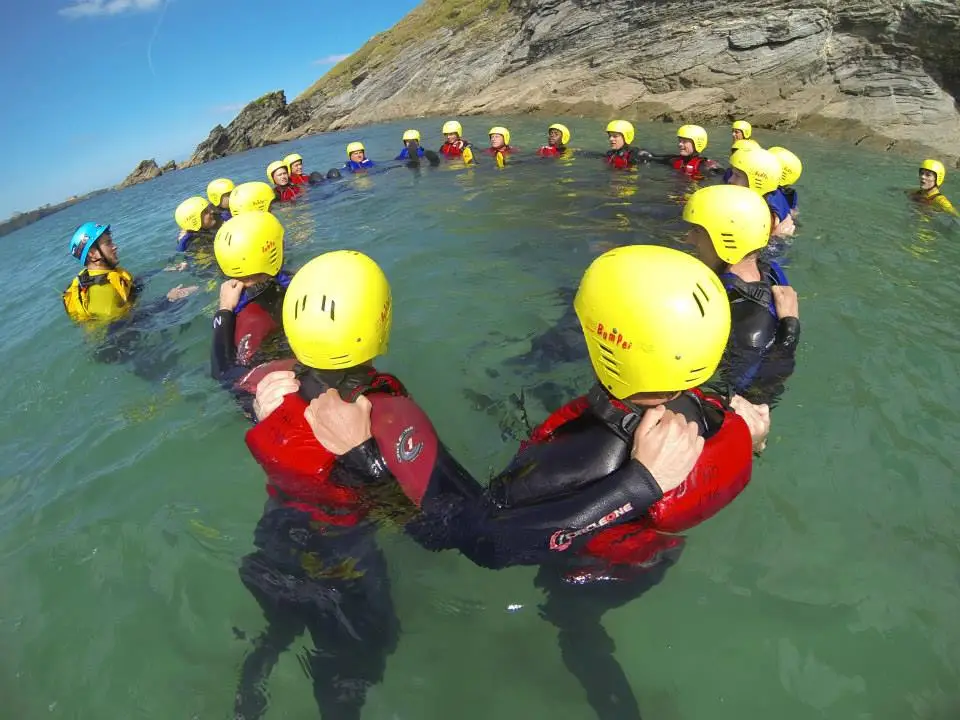
Coasteering guiding is a form of adventure guiding that involves leading groups along a coastal route, typically involving a combination of activities such as cliff jumping, rock scrambling, swimming, and exploring sea caves. The coasteering guide’s role is to navigate the coastal terrain safely, manage risks, instruct participants on techniques, and create an engaging and enjoyable experience.
Key Responsibilities of Coasteering Guides
- Route Selection and Navigation: Selecting the safest and most suitable route based on the group’s skill level and current sea conditions.
- Safety Management: Assessing risks, managing group safety, and carrying safety equipment like life vests, helmets, and first-aid kits.
- Instruction and Support: Teaching participants the necessary skills for safe coasteering, such as jumping techniques, swimming in open water, and climbing rocks.
- Environmental Stewardship: Educating participants about the local ecosystem and promoting responsible, low-impact practices to preserve the coastal environment.
Challenges Faced by Coasteering Guides
Variable and Unpredictable Weather and Sea Conditions
- Coastal weather and sea conditions can change quickly, making it challenging to ensure safe conditions for participants. Guides must continuously monitor the weather, tides, and sea states and be prepared to adjust or cancel routes when necessary.
Managing Diverse Skill Levels and Fitness
- Groups often include participants with varying fitness levels, swimming abilities, and comfort with heights. Guides must assess each participant’s abilities quickly, adapting the pace and route to match everyone’s comfort level without compromising safety or enjoyment.
Ensuring Safety and Risk Management
- Coasteering involves inherent risks, such as slips, trips, falls, or injuries from contact with rocks and underwater hazards. Guides must be vigilant, constantly assessing risk while keeping an eye on participants, providing safety instructions, and managing potential incidents.
Dealing with Psychological Barriers
- Participants may experience fear or hesitation, especially when faced with jumping from cliffs or swimming in open water. Guides need strong interpersonal and motivational skills to encourage and support participants, helping them overcome mental barriers and building their confidence.
Environmental Hazards and Wildlife
- Coasteering guides may encounter unexpected wildlife (e.g., jellyfish or sharp barnacles) or environmental hazards like slippery rocks or strong currents. Guides must be prepared to handle these encounters, mitigate risks, and educate participants on how to interact safely with the environment.
Physical Demands
- Guiding coasteering groups requires physical endurance, agility, and strength. Guides are often responsible for carrying safety equipment, swimming, climbing, and sometimes assisting participants physically. Maintaining fitness and stamina is essential to ensure safety and high-quality guidance.
Ensuring Group Cohesion and Communication
- In water-based and cliffside environments, maintaining clear communication and keeping the group together can be difficult. Guides must use specific techniques, such as hand signals and voice projection, to maintain order, relay instructions, and ensure everyone remains within sight.
Environmental Responsibility and Leave-No-Trace Principles
- Coasteering occurs in fragile coastal ecosystems, and guides must balance adventure with environmental respect. They must instill a sense of environmental responsibility in participants, promoting low-impact practices like respecting wildlife, avoiding littering, and minimizing disturbances to habitats.
Skills and Qualities Essential for Coasteering Guides
- Strong Swimming Ability and Physical Fitness: Guides must be capable of swimming in open water, climbing, and moving across slippery rocks.
- Knowledge of Tides and Weather Patterns: Understanding how tides and weather affect sea conditions is critical for route planning and safety.
- Effective Communication and Instruction Skills: Guides need to communicate safety instructions clearly and make participants feel secure.
- Calmness Under Pressure: Situations can arise quickly, so staying calm, thinking clearly, and acting decisively are crucial.
- Environmental Knowledge and Respect: Guides should understand local marine ecosystems and model responsible practices to ensure minimal environmental impact.
Conclusion
Coasteering guiding is a rewarding but challenging role that combines adventure, environmental stewardship, and strong leadership. The dynamic nature of the coastline requires guides to adapt quickly, handle physical and psychological challenges, and ensure that each participant’s experience is safe, memorable, and respectful of the natural environment

